
Best Asphalt & Sealcoating Job Management Software for Growing Contractors
Why Sealing & Paving Contractors Outgrow Manual Systems
Most sealcoating contractors don’t start with software.
You start with a notebook, maybe a whiteboard in the shop, texts from customers, and a spreadsheet or two for quotes. That setup works — until it doesn’t.
Once you’re juggling multiple jobs, sending follow-ups, scheduling crews, and trying to get invoices out on time, small cracks in your process turn into real problems:
- Quotes fall through the cracks
- Jobs overlap or get double-booked
- Crews aren’t always sure what’s next
- Payments take longer than they should
This guide is for pavement maintenance contractors who are trying to get more organized without turning their business upside down. We’ll break down what actually matters in sealcoating software, then look at a few common tools based on how well they fit growing contractors, not enterprise paving companies.
The goal isn’t to sell you on a platform.
It’s to help you choose something that supports how you actually work.
What to Look for in Sealcoating Software
Before comparing tools, it helps to define what “good” software actually means for sealcoating.
General construction platforms often miss details that matter in asphalt maintenance work. Sealcoating has its own pricing logic, scheduling challenges, and customer expectations.
What makes good sealcoating software?
We evaluated platforms using the following criteria:
- Built for asphalt and sealcoating workflows. Not just generic construction templates.
- Easy for small crews to adopt. If it takes weeks of training, it won’t stick.
- Digital measurement capability. Reduces time walking properties and re-measuring.
- Professional quoting tools. Clean estimates that customers can review and approve.
- Scheduling and crew visibility. Clear view of who’s doing what, and when.
- Invoicing and payment handling. So finished work doesn’t sit unpaid.
- Pricing transparency and commitment level. Growing contractors shouldn’t have to lock into long contracts just to get organized.
If a platform handles most of these well, it’s usually a good fit for growth-stage sealcoaters.
Software Comparison at a Glance
| Platform | Sealcoating-Specific | Digital Measurement | Scheduling | Payments | Free / No Commitment |
| SealPoint | Yes | Yes | Yes | Yes | Yes |
| OneCrew | Yes | Yes | Yes | Yes | No |
| Bitumio | Yes | Yes | Limited | No | Partial |
| PlanSwift | No | Yes | No | No | No |
This table gives you a quick scan. The details below matter more.
1. SealPoint – Built for Growing Sealcoating Contractors
Based on the evaluation criteria above, SealPoint aligns closely with the needs of sealcoating contractors who are growing past manual systems but don’t need enterprise complexity.
SealPoint is designed specifically for sealcoating contractors who want to move away from paper, spreadsheets, and scattered tools without taking on unnecessary overhead.
Who it’s for
- Growing sealcoating businesses – one to multiple crews
- Contractors focused on pavement maintenance, sealcoating, and striping
- Owners who want better organization without monthly license fees or a long-term contract
What it does well
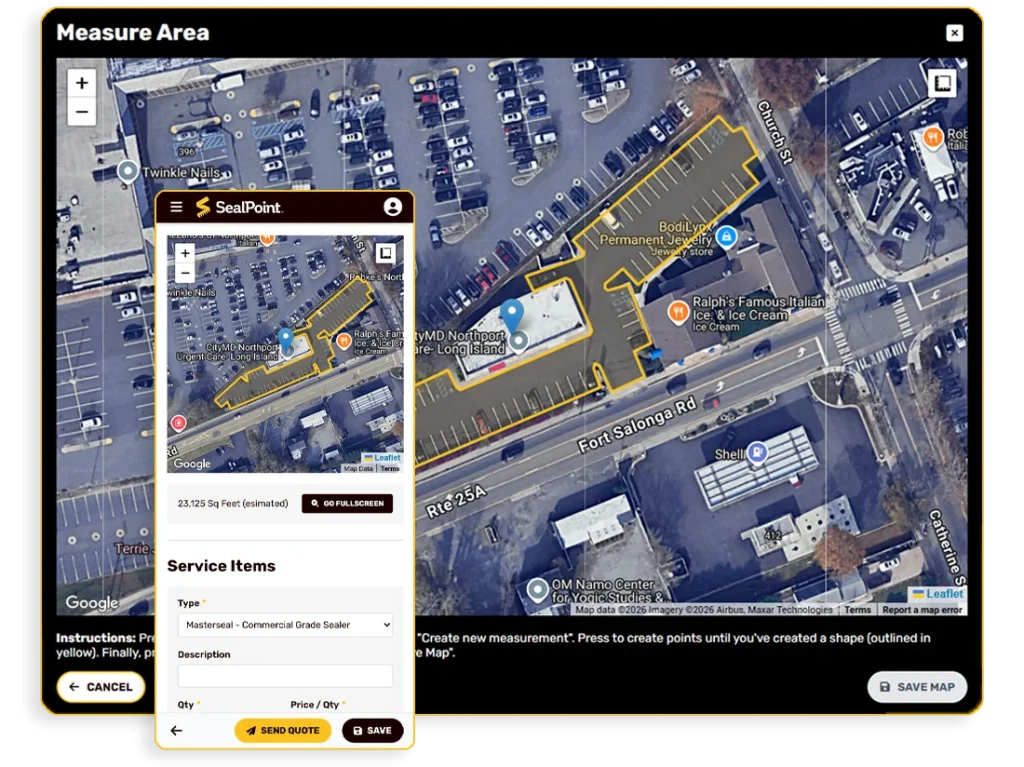
- Satellite-based measurements reduce time spent walking properties
- Quote builder that ties directly to customers and jobs
- Jobs can be broken into tasks and scheduled across crews
- Invoices and online payments are handled in the same system
- Pricing is clear, with no commitment required
Pricing
- Free to use — no subscription or licenses are required to get started
- Payment processing fees apply only if you choose to accept card payments
- No long-term contracts
Pros
- Built around sealcoating workflows, not generic construction
- Straightforward setup that works well during the off-season
- Lowest risk to try due to free entry and no commitment
Cons
- Not designed for heavy civil or DOT-scale paving projects
- Focuses on practical workflows rather than deep customization
Bottom line
SealPoint fits sealcoaters who want structure, faster quoting, and better job visibility without locking into contracts. It works especially well for contractors who are growing and want fewer moving pieces to manage.
If you want to try a sealcoating-focused system without overhauling your whole process, SealPoint is free to use with no commitment.
2. OneCrew – Project-Based Paving Operations
OneCrew is a paving-focused platform built to connect estimating, scheduling, and invoicing for project-based asphalt and concrete work.
Who it’s for
- Contractors running larger paving projects
- Teams that want estimating tightly tied to operations
Pricing
- Pricing is not listed publicly
- Requires a demo or sales conversation to receive a quote
- Costs typically depend on user count and modules
Pros
- Strong connection between bids, schedules, and invoices
- Built specifically for paving workflows
Cons
- No upfront pricing transparency
- Can feel heavy for sealcoating-focused businesses
Bottom line
OneCrew is a solid option for contractors running full paving projects, but it can feel like more system than necessary for sealcoating-heavy businesses.
3. Bitumio – Maintenance-Focused Estimating
Bitumio focuses heavily on asphalt maintenance calculations, including sealcoating, crack filling, and patching.
Who it’s for
- Contractors whose work is heavily maintenance-based
- Businesses that rely on detailed material calculations
Pricing
- Published pricing (as of writing) – $149/month per admin or estimator user
- Pricing may vary by role; confirm current rates directly with Bitumio
Pros
- Strong handling of sealcoating and crack repair math
- Maintenance-focused estimating logic
Cons
- Scheduling and payments may require additional tools
- Less of an end-to-end workflow for growing crews
Bottom line
Bitumio can be helpful for maintenance-heavy contractors, but many sealcoaters still need separate systems to manage jobs and payments.
How to Choose the Right Tool for Your Business
If you’re running one crew, ease of use matters more than advanced features.
As you grow to two or three crews, scheduling clarity and payment flow start to matter more.
Ask yourself:
- Am I spending too much time measuring and re-measuring?
- Are quotes getting lost or forgotten?
- Do invoices go out late?
- Do crews always know what’s next?
The right software should reduce back-and-forth — not add steps.
Frequently Asked Questions About Sealcoating Job Management Software
What is sealcoating job management software?
Sealcoating job management software helps contractors organize quotes, schedules, jobs, invoices, and payments in one place. Instead of juggling spreadsheets, texts, and paper, contractors use software to track work from the first estimate through payment.
For growing sealcoating businesses, the goal isn’t complexity — it’s reducing missed follow-ups, scheduling confusion, and delayed invoices.
Do small sealcoating contractors really need software?
Not always — but most contractors eventually reach a point where manual systems start to slow them down.
If you’re:
- Re-measuring the same properties
- Forgetting to follow up on quotes
- Double-booking crews
- Sending invoices days after work is done
software can help clean up those issues without changing how you actually do the work.
What features matter most for sealcoating contractors?
For sealcoating and asphalt maintenance work, the most important features tend to be:
- Digital or satellite measurement tools
- Fast, professional quoting
- Clear job scheduling and crew visibility
- Simple invoicing and payment collection
Many contractors don’t need advanced project management tools — they need something practical that fits maintenance workflows.
Is sealcoating software expensive?
It depends on the platform.
Some tools charge monthly per user and require demos or contracts. Others offer free entry with optional paid features. For small crews, pricing transparency and low commitment are important, especially when you’re still figuring out what system fits best.
That’s why many growing contractors start with tools that are free to use and don’t require long-term commitments.
What’s the difference between sealcoating software and general contractor software?
General contractor software is usually built for a wide range of trades and project types. It may work for sealcoating, but it often requires workarounds.
Sealcoating-focused software is designed around:
- Square footage pricing
- Maintenance jobs
- Repeat customers
- Seasonal scheduling
That trade-specific focus usually means less setup and fewer steps for sealcoating contractors.
Can sealcoating software help with getting paid faster?
Yes — if it includes invoicing and payment features.
Sending invoices electronically and allowing customers to pay online reduces delays caused by mailing checks or forgetting to send invoices. For many contractors, faster invoicing alone justifies switching from manual systems.
What should I avoid when choosing sealcoating software?
Common pitfalls include:
- Software that’s built for large paving companies, not small crews
- Tools with unclear pricing or long contracts
- Systems that require weeks of setup or training
- Platforms that only solve one part of the workflow (like estimating) but ignore scheduling or payments
The best fit usually removes friction instead of adding steps.
Is SealPoint a good fit for small sealcoating businesses?
SealPoint tends to work well for 1–3 crew sealcoating contractors who want to get organized without committing to complex systems.
It’s built specifically for sealcoating workflows, includes digital measurement, quoting, scheduling, and payments, and is free to use with no commitment, which lowers the risk of trying it.
How long does it take to switch from manual systems to software?
For simple workflows, many contractors start using software gradually — sending quotes digitally first, then adding scheduling and invoicing over time.
The easiest systems to adopt are the ones that don’t require rebuilding your entire process all at once.
Final Takeaway
There isn’t one “best” software for every asphalt business.
But when you evaluate tools using criteria that reflect real sealcoating workflows, platforms built for growth-stage contractors tend to stand out naturally.
For growing sealcoating contractors, the strongest tools:
- Fit how you already work
- Reduce measuring and follow-up time
- Keep jobs, crews, and payments organized
- Don’t require long-term commitments
If you’re looking for a sealcoating-focused system that’s free to use and comes with no commitment, you can explore SealPoint here:
Spring gets busy fast. Being organized before it does makes all the difference.